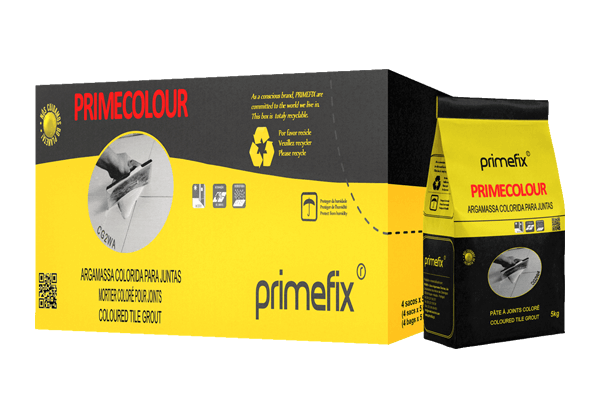
Primecolour-Plus
Classification CG2WA
Grouting mortar for joints from 2 to 10 mm, suitable for swimming pools, public bathrooms, industrial kitchens.
Packaging
5kg bags;
box with 4 5kg bags;
pallet with 30 20kg boxes (600kg)
Color
Various Colors
Description
Grouting mortar, type CG2WA, for ceramic and stone flooring and coverings, indoors and outdoors.




Properties
Mortar composed of loads with superior physical/chemical/mechanical resistance (cg2 classification), with good workability. It has low water absorption (W) and high abrasion resistance (A). Resistance greater than 24 hours.
Composition
Mortar composed of loads with superior physical/chemical/mechanical resistance (cg2 classification), with good workability. It has low water absorption (W) and high abrasion resistance (A). Resistance greater than 24 hours.
Support
Joints between ceramic floors and coverings and stone materials, placed on a cement support.
Application instructions
- Unsuitable conditions: avoid application on substrates that are hot, permanently humid, wet or where there is a possibility of water being present during or immediately after application; avoid application during periods of heat and intense sunlight (above 30ºC) and cold periods (below 5ºC).
- Respect the recommended amount of water in order to obtain a uniform, consistent and lump-free mixture. Too much water causes color changes and a decrease in the mechanical strength and shrinkage of the mortar.
- The water to be used must be clean. – Respect the waiting time before starting grouting (48 to 72 hours). Colour may change due to moisture from the cementitious adhesive that is still hydrating. Check for moisture and extend the waiting time in closed, unventilated areas on substrates with reduced absorption.
- On substrates with rising damp and/or water infiltration, this anomaly must be resolved beforehand.
- During application, tighten the mortar.
- In expansion and construction joints and on supports subject to mechanical vibration/bending actions and with very different expansion coefficients, use suitable elastic mastics and stress absorption profiles.
- The application and curing of joint mortar in radiant floor heating must be carried out with the equipment turned off.
- In large spaces and/or areas subject to fluctuating weather conditions, it is recommended to divide the surface into zones, delimited by elastic grouting or stress absorption profiles (for example: 5 x 5 m area).
- The gap created between the end of the tile and the change in direction of the support (for example: the gap between the tile on a floor and the vertical wall) should not be filled with grout. It can be covered with a skirting board or a molding or filled with an elastic mastic.
- The grouting of the joint must be done consistently and with the first cleaning, by scraping, at the time of application.
- Sponge cleaning water should be changed frequently. The sponge should be wrung out well.
- Avoid adding product and/or water to the already mixed mortar, particularly when it reaches the hardening process.
- Avoid cleaning with corrosive products.
- Mix 5 kg of powder in approximately 1.8 L of clean water, manually or with a slow electric mixer, until you obtain a consistent, homogeneous and lump-free mixture. Use a container and tools free from contamination;
- Let the mortar rest for 2 minutes before starting to apply it;
- Apply the mortar using a grouting trowel, moving diagonally to tighten the mortar. Leave a minimum of mortar on the coating.
- Start cleaning when the hardening process begins (greater consistency and reduced surface shine) with a damp sponge with rounded corners.
- After 24 hours, perform a general cleaning with a damp cloth. You can also use an abrasive fiber or sisal scrubber.
Technical Data
|
Mortar presentation : |
Dry powder |
|---|---|
|
Granulometry : |
≤ 100 μm |
|
Apparent specific weight of powder : |
1,0 Kg/dm3 |
|
Application : |
Indoor/Outdoor |
|
Operating Temperature : |
5º C a 30º C |
|
Amount of water in the mixture : |
0.38 L/kg of powder |
|
pH: |
12 |
|
Color of hardened mortar : |
White |
|
Minimum time to start grouting : |
48 to 72 hours after laying the tiles |
|
Resting time after mixing : |
2 minutes |
|
Time of use of fresh mortar : |
1 hour |
|
Primary cleaning time after application : |
1 hour |
|
General cleaning time : |
24 horas |
|
Minimum commissioning time : |
7 dias |
|
Volumetric weight of fresh mortar : |
1,78 Kg/dm3 |
|
Yield : |
1.30 kg powder/ dm3 |
|
Cleaning : |
Use water |
|
Packaging : |
5kg bags; box with 4 5kg bags; pallet with 30 20kg boxes (600kg) with dimensions of L=1m x W=1m x H=0.9m |
|
Storage : |
1 year in original, closed packaging, protected from humidity. |
|
Consumption Calculation Methods : |
|
|
Analytical Calculation : |
Quantity of powder in Kg per m2 of area to be coated: |
|
a |
= length of the piece to be glued in cm |
|
b |
= width of the piece to be glued in cm |
|
e |
= joint thickness in mm |
|
p |
= thickness of the part to be glued in mm |
|
Tabled consumption values (consult Primefix) : |
The values shown give the powder consumption per m2 of area to be coated. Each table corresponds to a fixed value for the thickness of the pieces, and as variables, the dimensions of the pieces/thickness chosen for the joint. |
CE Marking Data
|
Determination of abrasion |
≤ 1000 mm3 |
|---|---|
|
Flexural strength (28 days) |
≥ 2,5 MPA |
|
Flexural strength after freeze-thaw cycles |
≥ 2,5 MPA |
|
Compressive strength (28 days) |
≥ 15 MPA |
|
Compressive strength after freeze-thaw cycles |
≥ 15 MPA |
|
Shrinkage |
≤ 3 mm/m |
|
Water absorption (30 min) |
≤ 2 gr |
|
Water absorption (240 min) |
≤ 5 g |
Receive additional information